
Thermal Mass Flow Meters Transform Gas Measurement
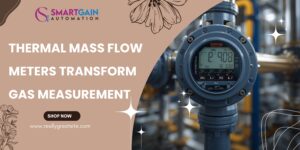
Thermal mass flow meters are a revolutionary advantage for accurate gas flow measurement, even without pressure or temperature compensation. Gulf Industrial Supply Dubai offers top-quality thermal mass flow meters that are built for long-lasting performance in tough industrial environments in the UAE. In case you need to measure the consumption of compressed air, check the usage of natural gas, or regulate the flow of process gases, our thermal mass flow meters are here to give you the accuracy and strength that your systems require.
Why Thermal Mass Flow Meters Transform Gas Measurement
Traditional volumetric flow meters typically require various complex and time-consuming compensation calculations that need to be adjusted for changes in pressure and temperature. Thermal mass flow meters on the other hand, measure the actual mass flow directly and thus do not require any compensation and also provide better accuracy at changing conditions. This core advantage is what makes them the best choice for compressed air systems, natural gas monitoring, and process gas applications, where either conditions change or the measurement needs to be simple.
Direct Mass Measurement Simplifies the Entire Process
Our thermal mass flow meters perform one simple step of measuring the true gas consumption and this is irrespective of pressure or temperature variations. The direct measurement gives the real data without the need for mathematical corrections which may introduce errors. In the case of a compressed air system where pressure varies throughout different parts of a facility or a natural gas measurement where temperature varies with seasons, thermal technology is the one that can provide the same level of accuracy all the time that volumetric meters cannot. Apart from the installation cost which reduces due to the elimination of pressure and temperature transmitters, measurement reliability is also enhanced due to the removal of calculation uncertainties.
Excellent Turndown Ratios Cope Well With Variable Flow
The production processes are never on a constant flow rate—the demand changes throughout the shifts and production cycles. The thermal mass flow meters have turndown ratios as high as 100:1 and even more which allows them to keep accuracy at the minimum flow that could be as low as 1% of full scale coming from the maximum flow. The high sensitivity in the case of compressed air leak detection is what helps reveal such small leaks that hardly consume energy and are thus invisible. For process control purposes, this rangeability can serve industrial plants during their startup, normal operation, and even shutdown phases ensuring they are accurate at all times.
The Absence of Movable Elements Guarantees the Device’s Reliability
Conventional mechanical flow meters are built with components that undergo wear and tear and hence require maintenance and replacement of parts. A thermal mass flow meter is a unit without any moving parts as the measurement is done via solid-state thermal sensing elements. Such an arrangement offers the customer his/her equipment free of charge from maintenance operations for a long time thus it is of a lower lifecycle cost and at the same time there are no measurement interruptions. Apart from the scenarios with vibration, pulsation, or contamination, medium conditions thermal technology can be considered as having the longest service life and most exceptional dependability.
Comprehensive Thermal Mass Flow Meter Solutions
Our thermal mass flow meter range features inline flow meters for pipe sizes of 6mm to 300mm, insertion flow meters for large air ducts, where it is not feasible to perform an inline installation, high-temperature models designed to handle process gases at temperatures of up to 400°C, and units certified for use in hazardous areas with ATEX and IECEx approvals for explosive atmospheres. The digital displays indicate the instantaneous flow rate and totalized volume, whereas the 4-20mA and pulse outputs can be used for connection with remote control systems and SCADA platforms.
Compressed Air Management:
The generation of compressed air accounts for 10-30% of the total electricity consumption of a manufacturing plant, however, many facilities have no idea about the consumption patterns. Our thermal mass flow meters are the right tools for the implementation of energy-saving programs. The installation of flow meters at the compressor outlet allows the tracking of overall production. Metering on the departmental level is used for the correct allocation of costs. Measurement at the level of equipment helps you find energy-consuming processes. What is even more important is that baseline measurement during non-production hours enables you to detect system leaks, which, in most cases, account for 20-40% of compressed air production in facilities that have no active leak management. The savings on energy caused by fixing the identified leaks usually cover the cost of the measurement system within a few months.
Natural Gas and Process Gas Monitoring:
Precise natural gas metering is a prerequisite for utility cost management and process control. When there is a need, our thermal mass flow meters conform to the custody transfer standards, thus being suitable for metering that is subject to commercial transactions and measure that can be used as a legal base. On the contrary to volumetric meters, which require compensations and thereby introduce uncertainty, thermal technology offers direct mass flow measurement with the highest level of accuracy. Examples of applications are main feed measurement at a facility for billing verification, departmental metering for internal cost allocation, process burner measurement for control optimization, and boiler fuel monitoring to facilitate energy management initiatives.
Customer Success from UAE Industries
“Our compressed air costs were unsustainable, but we lacked data showing consumption patterns. Gulf Industrial Supply installed thermal mass flow meters throughout our distribution system. The results shocked us—we discovered 35% of compressed air production was lost to leaks, equivalent to AED 180,000 annually in wasted electricity. After addressing identified issues, our air compression costs dropped 30%. The measurement system paid for itself in four months.” — Khalid Al-Hamadi, Facilities Manager, Dubai Industrial Manufacturing
“As a natural gas distributor requiring custody-transfer-grade measurement, volumetric meters with compensation were complex and introduced uncertainties causing customer disputes. After transitioning to thermal mass flow meters, our measurement accuracy improved significantly. The meters provide direct mass flow without compensation calculations, eliminating errors and complaints. Installation costs dropped because we eliminated pressure and temperature transmitters. These thermal meters were exactly what our operation needed.” — Fatima Al-Zarooni, Operations Director, Emirates Gas Distribution
Your Questions Answered
How do thermal mass flow meters work?
Thermal mass flow meters employ heated sensor elements and temperature sensors. When the gas flows along the heated element, the element’s temperature decreases as the gas absorbs heat. The meter determines the heat transfer and thus the mass flow rate from the measured temperature difference in the heat transfer calculation. Since heat transfer is directly related to mass rather than volume, the measurement is not affected by changes in pressure or temperature that change the gas density.
What advantages do thermal meters offer?
The direct mass flow measurement without the need for compensation reduces both the costs and the uncertainties. Extreme 100:1 turndown ratios allow the flowmeter to be used across a wide range of flow rates and still keep the accuracy. The absence of moving parts guarantees a maintenance-free operation. The very small pressure drop keeps the system pressure intact. The vibration resistance of the meter ensures a stable output signal. For compressed air, natural gas, and clean gases, thermal technology is often the best combination of performance, reliability, and total cost of ownership.
What maintenance is required
Thermal mass flow meters are almost maintenance-free as they have no moving parts that could wear out. In clean gas applications, the meters are usually 5-10 years between calibration verifications. An annual visual inspection and calibration verification using traceable standards at intervals are our recommendations. The very small maintenance involved here is the main reason for which the lifecycle costs of these meters are dramatically lower compared to those meters which are mechanical and require regular servicing
Call : + 971 569650224
Email : info@smartgain.me
Visit : [https://www.gulfindustrialsupply.com/