Parker solenoid valve suppliers in UAE fall into two real categories: authorized distributors who can trace their stock back to Parker Hannifin’s regional operation, and resellers who can’t. That distinction decides whether the valve on your bench actually meets the coil voltage, seal, and pressure rating printed on the datasheet — or just looks like it does. Get that wrong on a gas line and you’re not troubleshooting a nuisance trip; you’re troubleshooting a safety incident.
I’ve spent two decades sourcing and specifying industrial control components across the Gulf, and solenoid valves are one of those parts everyone assumes is simple. It isn’t. A 1-inch brass body with a coil bolted on top hides a handful of decisions — normally closed or normally open, 220V/50Hz or 240V/60Hz, NBR or something else entirely — that determine whether the valve survives six months or six years.
Where “Parker” Actually Comes From in This Market
Parker Hannifin is a US-headquartered manufacturer of motion and control components — hydraulics, pneumatics, filtration, and yes, solenoid valves. Its Middle East presence runs through Parker Middle East FZE, based in Dubai, which supplies the free-zone and mainland distribution network that feeds the wider GCC. Almost nobody buying a single valve for a maintenance job talks to Parker Middle East FZE directly. Instead, you’re buying from an authorized reseller who holds regional stock, or from a general industrial trading company that sources through a longer, murkier chain.
That second option isn’t automatically bad. Plenty of trading houses in Dubai Investment Park and Al Quoz move genuine parts at fair margins. But “murkier chain” means more hands the part passes through before it reaches you, and more opportunities for a mislabeled unit, a mismatched coil, or a valve that’s been sitting in an uncontrolled warehouse for three years to end up in your cart.
What the Valve Is Actually Doing
Skip the textbook definition — you know a solenoid valve opens or shuts a flow path electromechanically. What matters operationally is the failure state. A normally closed (NC) valve stays shut with no power; energize the coil and it opens. That’s the default choice for gas shutoff and safety-critical lines, because a power loss fails the system safe. A normally open (NO) valve does the opposite — it’s open by default and closes on signal. NO configurations show up far less often in gas safety circuits and more often in process loops where you want continuous flow unless something specifically tells the system to stop.
Mixing these up isn’t a paperwork error. Install an NO valve where your process expects fail-closed behavior and a power outage leaves the line open when it absolutely shouldn’t be.
Where UAE Buyers Actually Get This Wrong
Three mistakes show up again and again on maintenance calls and procurement rework:
- Coil voltage assumed, not confirmed. UAE supply is 220–240V at 50Hz. Some Parker coils are dual-rated for 240/60Hz and 220/50Hz — check this explicitly rather than assuming a US-spec coil will run clean indefinitely on a 50Hz grid. It might work. It might also run hotter and shorten coil life.
- Trusting the marking over the paper trail. A brass body stamped “Parker” tells you almost nothing on its own. Ask for the manufacturer’s part number, cross-reference it against an authorized distributor’s catalog, and request origin documentation before committing to a bulk order — not after the valves are installed.
- Ignoring seal chemistry against the actual media. NBR seals handle general industrial gas and liquid service well. They are not the automatic right answer for every LPG or aggressive-chemical application. If your process runs something outside NBR’s comfort zone, raise that with the supplier before ordering, not after a leaking gland six months later.
Parker Solenoid Valve 1-Inch N.C — Spec Breakdown
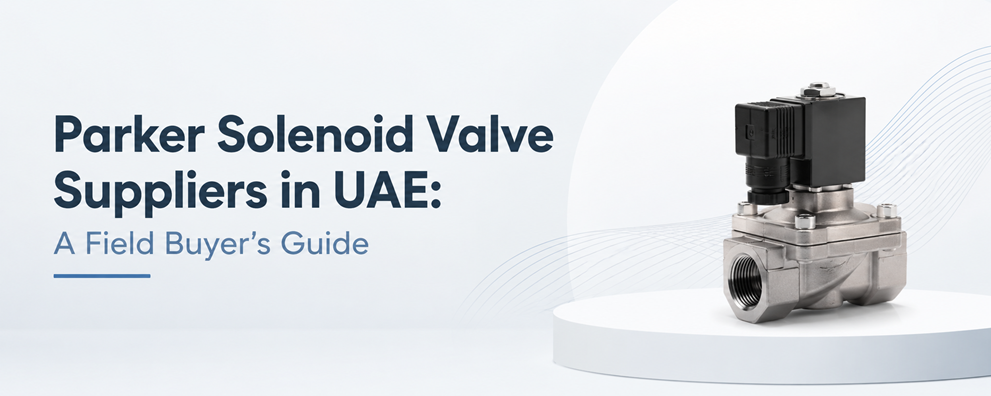
Here’s a representative spec sheet for a Parker 1-inch normally closed solenoid valve, the size most commonly requested for gas and liquid shutoff service in the region:
| Specification | Detail |
| Configuration | 1-inch, Normally Closed (N.C.) |
| Working pressure | Up to 20 Barg |
| Seal material | NBR |
| Coil voltage | 240V/60Hz and 220V/50Hz |
| Body material | Brass |
| Enclosure protection | NEMA-rated |
| Typical supply region | UAE, Saudi Arabia, Kuwait, Oman, Bahrain, Qatar, and wider GCC |
Treat listed prices as a starting reference rather than a fixed number — freight, VAT treatment, and order volume shift the final quote, sometimes by a meaningful margin on a single-unit purchase versus a case order.
Genuine Distributor or Grey-Market Reseller — How to Tell
Ask three questions before you place an order, and pay attention to how confidently they’re answered:
- Can you name your source? A legitimate distributor won’t dodge this. They’ll tell you whether stock comes through Parker Middle East FZE, an authorized regional partner, or direct import — and back it up with a trade license and, ideally, a distributor agreement reference.
- Do you carry spares, not just the full unit? Coils burn out independently of the valve body far more often than people expect. A supplier who only sells complete assemblies and has never stocked a replacement coil kit is usually a reseller, not a stocking distributor.
- What’s your NEMA certification paperwork? If the valve is rated for hazardous or high-risk enclosures, the supplier should produce that documentation without a three-day delay.
Local Stock vs Ordering Through Parker Middle East FZE Direct
This is a genuine trade-off, not an “always pick option A” situation.
Going direct through Parker Middle East FZE makes sense for large-volume orders, custom coil configurations, or specifications outside the standard catalog. You get factory-traceable stock and, usually, better unit economics at scale. The cost is lead time — weeks, not days — and often a minimum order quantity that doesn’t suit a single failed valve on a Tuesday.
Buying from an authorized reseller with UAE-held stock wins on speed. If a valve fails on a live gas line and the plant is down, you need same-week replacement, not a factory-order cycle. The trade-off is a narrower catalog and slightly higher per-unit pricing to cover the carrying cost of local inventory.
For planned procurement and turnaround projects, go direct or through a distributor with confirmed lead times. For breakdown maintenance, a Dubai-based supplier with same-day or next-day stock is worth the premium.
Field Notes: What Actually Shortens Valve Life
Most premature solenoid valve failures I’ve seen traced back to installation and maintenance habits, not manufacturing defects:
- No upstream strainer. Pipeline debris fouls the seat and prevents full closure, which reads as a “faulty valve” when it’s really a filtration gap.
- Wrong mounting orientation. Some solenoid valves are coil-up only; mounting sideways or inverted can affect plunger travel and long-term reliability.
- Voltage mismatch left unaddressed. A coil running slightly out of its rated voltage band doesn’t fail immediately — it runs hot, degrades insulation faster, and fails months earlier than it should have.
- Skipped periodic cycling. A valve that sits in one position for months without cycling can seize or develop seat deposits. Scheduled exercise cycles catch this before it becomes an emergency call.
Where These Valves Actually Get Used
Ask a handful of UAE facilities managers where their Parker solenoid valves are working and the answers cluster around a few applications: LPG auto-gas station dispensing lines, natural gas pressure-regulation skids, petrochemical fluid-control loops, and general industrial process automation where a PLC needs to open or shut a flow path on command. Fuel handling setups lean on solenoid valves for emergency shutoff — the NC configuration again, because a tripped breaker or a cut cable should default the line to closed, not open.
Vaporizer and SNG plant setups are a slightly different case. Cycling frequency tends to be higher there, which puts more wear on the coil and seat over a shorter calendar span than a valve that opens once and stays open for a production run. If your application involves frequent cycling, ask the supplier about duty-cycle ratings specifically — a valve rated for occasional actuation isn’t necessarily rated for thousands of cycles a month, even if the pressure and voltage specs look identical on paper.
What Separates a Reliable Solenoid Valve Supplier in Dubai
Price comparisons matter, but they’re not the whole picture. A supplier worth building a repeat relationship with usually shows a few consistent traits: documented stock depth rather than “we’ll check with our supplier,” the ability to quote spare coils and seal kits alongside the full valve, technical staff who can answer a voltage or pressure-rating question without escalating it, and clear coverage of the wider GCC supply area so a multi-site operation isn’t juggling different vendors per country.
Why Prices Vary Across the Region
A handful of factors explain why two suppliers can quote noticeably different numbers for what looks like the same part: whether the price includes UAE VAT, freight and customs handling on imported stock versus locally held inventory, order volume, and whether the coil variant requested is a standard stock item or a made-to-order spec. None of these are red flags on their own — but a quote dramatically below every competitor’s is worth a direct question about sourcing before you accept it.
FAQs
What is the typical price of a Parker solenoid valve in Dubai?
Pricing depends on size, pressure rating, and coil spec, but a 1-inch N.C. brass-body Parker solenoid valve typically runs in the low thousands of AED for a single unit. Always confirm the current quote directly with the supplier, since freight and VAT treatment shift the final figure.
Are there authorized Parker solenoid valve distributors in the UAE?
Yes. Parker Hannifin operates in the region through Parker Middle East FZE in Dubai, and a network of authorized resellers carries regional stock. Ask any prospective supplier to confirm their position in that chain before ordering in bulk.
What’s the practical difference between NC and NO solenoid valves?
A normally closed (NC) valve stays shut without power and opens on signal — the standard choice for gas shutoff and safety-critical service. A normally open (NO) valve does the reverse, staying open by default. Choosing the wrong one affects what happens to your process during a power loss.
Can a Parker solenoid valve handle LPG service?
Many models with NBR seals are suited to general LPG and gas service, but seal chemistry needs to match the specific media and operating temperature. Confirm the seal spec against your application with the supplier rather than assuming compatibility.
How do I confirm the coil voltage before ordering?
Check the coil’s rated voltage and frequency against your local supply (220–240V/50Hz in the UAE) and ask the supplier directly if the unit is dual-rated for 240/60Hz and 220/50Hz operation, which several Parker solenoid coils are.
Before You Order
Confirm four things with any Parker solenoid valve supplier in UAE before payment: sourcing traceability, coil voltage match to your local supply, seal compatibility with your process media, and whether spare coils are stocked separately. A supplier who answers all four without hesitation is the one worth building a repeat order relationship with.